
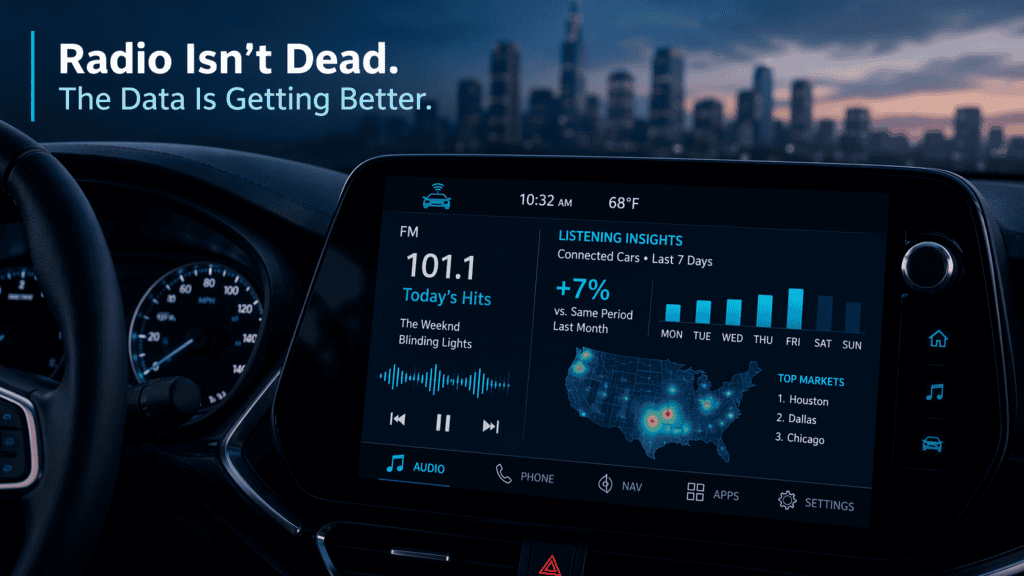
Radio Isn’t Dead. The Dashboard Data Finally Proves the Story Is More Complicated.
By Jason Kidd – President/CEO of New Generation Radio, home of VirtualJock.com and LocalFirst
With NAB opening this weekend in Las Vegas, the timing could not be better. As radio gathers to talk about the future, one of the biggest stories may be sitting right in front of the industry: the dashboard is finally becoming measurable in a much more meaningful way.
For years, radio’s obituary has been written by people looking at only part of the picture. Bluetooth, Spotify, podcasts, SiriusXM, and personal playlists are all real parts of the modern audio story. But “audio has changed” is not the same thing as “radio has disappeared.” What’s changing now is that the dashboard is finally becoming measurable in a more direct way. Xperi’s DTS AutoStage Broadcaster Portal says it can provide broadcasters with near-real-time in-car listening insights, and Xperi says the platform now reaches more than 16 million vehicles globally across 13 automotive brands and about 302 U.S. markets.
That matters because for a long time, the debate around radio in the car has been driven more by assumption than by hard usage data. Xperi describes the portal as giving broadcasters visibility into station reach, daypart activity, geographic heat maps, and listening trends, while the newer premium tier adds competitive station rankings, expanded charts, and exportable reports. In other words, radio is starting to get something closer to streaming-style intelligence about what people are actually doing once the car starts moving.
The old “radio is dead” argument is too simplistic
The lazy argument is that because people can connect their phones and bring their own audio into the car, radio must have already lost the dashboard. But that argument skips over actual behavior. Connected-car measurement is beginning to show that even in a world full of options, broadcast radio is still very much in the mix. The point is not that radio has no challenges. It clearly does. The point is that the “nobody listens anymore” line gets a lot shakier once actual in-car usage starts showing up in measurable form.
What DTS AutoStage actually is
DTS AutoStage is not just a tuner. Xperi positions it as a connected-car platform that blends broadcast and IP-delivered content in the vehicle, while the Broadcaster Portal turns listening behavior from enabled vehicles into analytics stations can actually use. Publicly, Xperi says the premium tier now includes station rankings by daypart and market, along with broader intelligence designed to help broadcasters understand competitive position in the dash.
Which automakers are in the sample right now
As of Xperi’s latest public release, DTS AutoStage spans these 13 automotive brands: Mercedes-Benz, Maybach, Hyundai, Genesis, Kia, BMW, MINI, Ford, Lincoln, Nissan, Infiniti, Tesla, and Audi. That is a meaningful footprint, but it is still not every vehicle on the road. That distinction matters because it means this is powerful data, but not yet a full-market census of every dashboard in America.
How the platform has grown
This is also why the data matters more now than it did at the beginning. Xperi says the platform now processes more than 12 billion pieces of data monthly, and public trade coverage around the portal has positioned it as one of radio’s biggest steps yet toward true in-car measurement at scale. That does not mean every question is answered. It does mean the conversation is becoming far more evidence-based than it used to be.
What we’re seeing in actual markets
And this is where things get interesting. I’ve now seen here in Washington, DC a recent report of 76,002 cars for the week of April 6–12, 2026. In that market view, WTOP is #1, 93.9 WKYS is #2, (My former station) WPGC is #3, HOT 99.5 is #4, and WAMU 88.5 is #5.
This Washington example is exactly why this deserves attention. HOT 99.5 has often felt weaker in broader legacy-ratings conversations than many in the business would expect, yet in this connected-car snapshot it shows up at #4. That does not mean one system replaces every other methodology overnight. It does mean the in-car story may be more nuanced than the industry’s usual talking points.
Also, I should note that in New York, Z100 is #1, with Hot 97 at #4. If that pattern holds, it would be another reminder that the connected-car view may not always mirror the assumptions people carry around about who is really winning in the dash.
Why format results may still shift
This is where things get even more important for programmers and operators. Because the current data comes from a growing OEM footprint rather than every single make and model on the road, some formats may be overrepresented or underrepresented depending on which vehicles are in the mix. That means rock, country, talk, or other formats may look different as more manufacturers come online. That is an inference, not a direct Xperi claim, but it is a fair caution when interpreting any growing sample.
And that is a big deal. If certain manufacturers that skew more blue-collar, truck-heavy, or workday-heavy are not yet fully represented, then certain formats may be getting shortchanged in the early read. That does not make the data bad. It just means smart programmers should read it as a powerful evolving tool, not gospel carved in stone.
Why this matters beyond just measurement
This is bigger than just another scoreboard for programmers to stare at. As more car manufacturers come onboard, the data should become more complete, more representative, and more useful to take to agencies and advertisers. If radio can walk into the room with stronger proof of actual in-car behavior, that can help stations financially, help sellers tell a better story, and potentially shift dollars back toward broadcast in a more meaningful way.
And there is a programming implication too. Better dashboard data may not just help radio sell itself better. It may also help radio get creative again. If programmers can see clearer patterns around actual in-car usage by market, by daypart, and by station, it opens the door to smarter format decisions, sharper positioning, and a better understanding of what is really connecting in the car versus what only looks good on paper.
That also leads to the part nobody likes to say out loud: if better data helps stations prove value more effectively, it can also possibly help save jobs. Radio has spent years fighting budget pressure, cuts, and consolidation. Anything that gives the medium a clearer story to sell — and a more accurate picture of its real audience — has real business value beyond bragging rights.
At the same time, the current OEM mix may still be skewing some results. In some markets, male-dominant formats may not score as well yet because key manufacturers are still missing or underrepresented. That could be especially true in blue-collar markets, where vehicle mix matters and brands like GM have traditionally had a stronger footprint. That is still an inference, not a proven conclusion, but it is an important one to keep in mind as the sample grows.
If you want it even tighter and punchier, use this version instead:
Why This Really Matters — Especially at NAB
With NAB opening this weekend, this conversation stops being theoretical. Xperi is launching and demonstrating DTS AutoStage Broadcaster Portal Premium at the show, putting connected-car measurement directly into the middle of radio’s biggest annual industry gathering.
As more car manufacturers come onboard, this becomes more than a cool research toy. It becomes something radio can take to agencies, advertisers, and clients as proof of actual in-car behavior. That can help stations financially, help the industry make a stronger sales case, and potentially bring back dollars that have been too easy to write off.
It could also help radio get creative again. Better data leads to better programming decisions, better format strategy, and a better understanding of what is actually working in the car.
And yes, there is an even bigger implication: if stations can prove value more clearly, this kind of data can possibly help save jobs too.
It is also worth noting that some male-dominant formats may not be showing their full strength yet in certain markets because the OEM sample is still incomplete. If key manufacturers like GM are missing, that can affect blue-collar markets in particular and may understate the performance of formats that depend heavily on those listeners.
That is what makes this moment so important. This is no longer just a debate about whether radio still belongs in the dash. It is becoming a business conversation about how stations can use real in-car behavior, daypart rankings, heat maps, and market spillover data to sell smarter, program smarter, compete harder, and make a stronger case for their future.
AutoStage, Quu and Wejo are part of the same dashboard battle — but they are not the same thing
There are several dashboard conversations happening at once, and they matter for different reasons. DTS AutoStage is about the connected-car platform and listening analytics. Quu is about the visual experience in the dashboard — text, images, logos, metadata and synced messaging that make broadcast radio look more modern inside the vehicle. Wejo, meanwhile, represented another lane entirely: connected-vehicle data that Capitol Broadcasting said could help show when people were listening in cars, what they were hearing and for how long. That distinction matters, because these tools all touch the dashboard, but they do not do the same job.
Quu’s 2025 In-Vehicle Visuals Report helps show how competitive the dash has become. Quu says 100% of the top 100 best-selling new models surveyed had FM, 98% had AM, 94% had SiriusXM capability, 98% had Apple CarPlay and Android Auto, 67% were HD-equipped, 100% could display radio text and 60% could display radio images. At the same time, only 26% were described as “radio-forward,” while 74% were “audio-forward.” That is not a picture of radio disappearing. It is a picture of radio being forced to compete harder, look better and earn its place on a much more crowded screen.
Xperi and Quu also announced an integrated solution in 2022, which helps explain why the two names overlap so often in radio conversations even though they are not the same product. AutoStage is measurement and platform intelligence. Quu is presentation and visual execution. They are fighting on the same field, just on different parts of it.
Where Sunrise Broadcasting and WKXB fit into this conversation
Not every station in this conversation is tied to the same technology, and that is important to make clear. I have not verified any direct public connection between Sunrise Broadcasting in Wilmington, specifically WKXB Jammin’ 99.9, and Xperi’s DTS AutoStage platform. I do not want to overstate something I could not nail down. What is public, though, is that Capitol Broadcasting, Sunrise’s parent, announced a partnership with Wejo in 2022 around connected-vehicle data and infotainment insights for broadcasters and advertisers. In other words, Sunrise’s orbit was already part of this broader move toward real in-car behavior data, even if that was through a different company and a different measurement lane than AutoStage.
What I can say is this: stations like WKXB are exactly the kind of brands this dashboard fight matters for. In my opinion, Jammin’ 99.9 is one of the best small-market radio stations in the country. Smart local stations with strong identity, real-world relevance and a product people actually use in the car have a lot to gain from both better in-dash presentation and better in-car measurement.
Whether you are talking about Xperi’s measurement layer, Quu’s visual layer or the connected-vehicle-data work Capitol explored with Wejo, the stations that win are going to be the ones that understand the dash is no longer just a speaker. It is a screen, a menu, a brand environment and increasingly, a data source.
What if part of the issue is not listening, but image?
Radio may be far from dead, but in some cases it may have a cool-factor problem. People may not always want to admit how often they still listen out loud, because streaming sounds more modern and more on-brand. But the dashboard does not care about image. It measures behavior. And if the data keeps showing that radio is still very much in the mix, then the real gap may be between perception and reality.
What this means for radio
The biggest takeaway from all of this is not “radio is back” and it is not “Nielsen is dead.” The real takeaway is that radio finally has another serious layer of evidence about actual in-car behavior. For years, too much of the conversation has been built on vibes: “my kids don’t listen,” “people only stream,” “cars don’t even want radio anymore.” Connected-car analytics do not erase the disruption. But they do make the conversation smarter.
And that may be the most important part of all. The dashboard conversation is no longer just philosophical. It is becoming measurable. Publicly, we already know the platform spans 13 brands, more than 16 million vehicles globally, around 302 U.S. markets, and billions of monthly data points. We also know from Quu’s dashboard work that radio is still everywhere in the vehicle, even if it is often harder to find, surrounded by more competition, and increasingly dependent on visual execution as well as audio execution.
Closer
Radio absolutely has challenges. Everyone in the business knows that. But the idea that the dashboard has already been completely lost is too neat, too easy, and probably too early. Connected-car data is starting to show that listening behavior is more complicated than the usual social-media obituary. And as more manufacturers come into the system and as more stations treat the dashboard like a true competitive battleground instead of an afterthought. The industry may finally get a cleaner picture of what has actually changed, what has been underestimated, and what still matters every time someone starts the car.



No comment yet, add your voice below!