How Much of the FM Dial Is Too Much?
By Jason Kidd
Programmer, Talent, President/CEO
Another great radio brand disappeared at midnight. At some point, we need to have a serious conversation about what is happening to the FM dial.
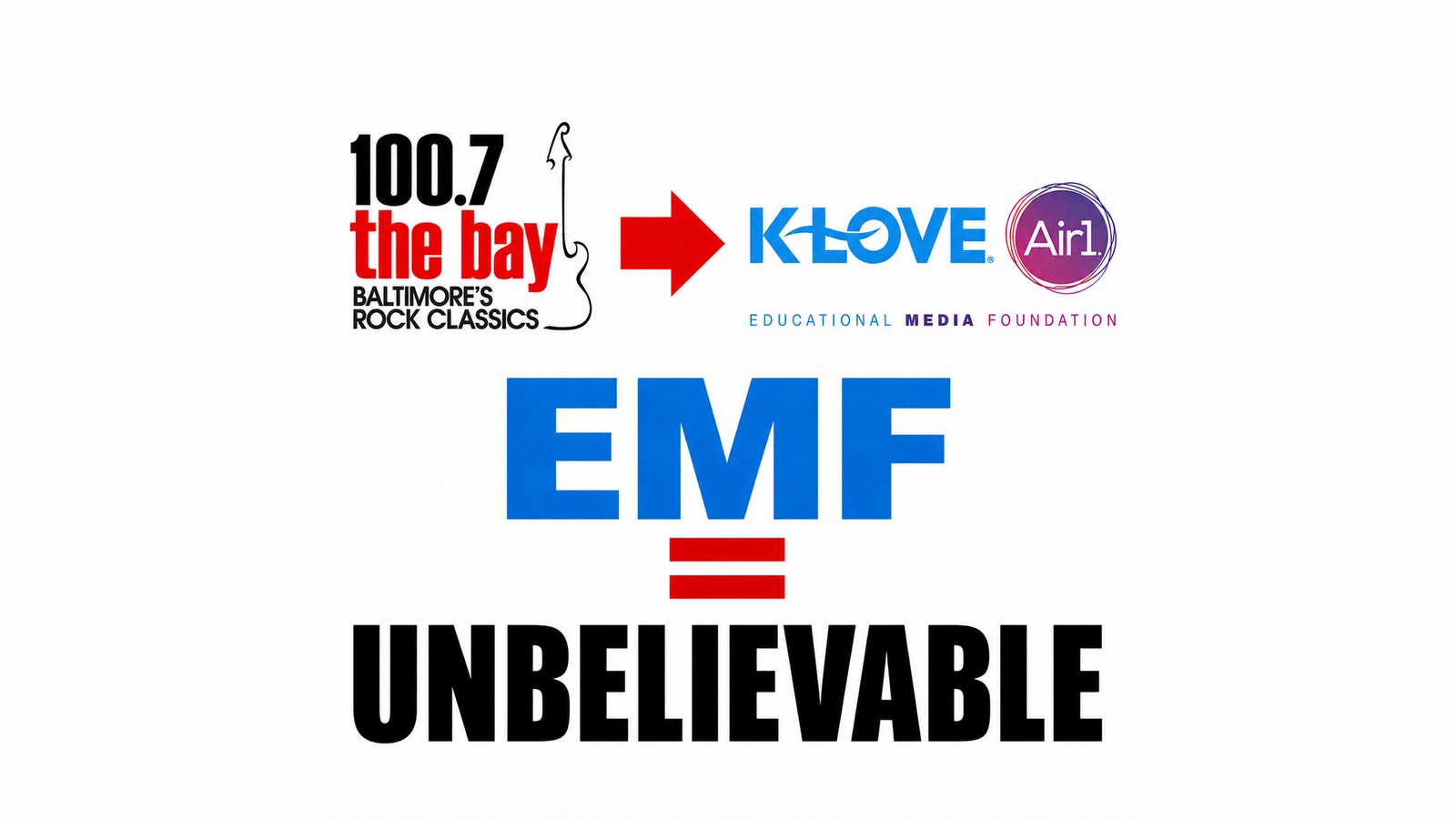
At midnight last night, Baltimore lost another longtime radio station. 100.7 The Bay, a station that has been part of the market for decades and has spent more than 25 years as Baltimore's Classic Rock station, signed off. Educational Media Foundation bought the station, and 100.7 is becoming another K-LOVE affiliate. There are some great people at The Bay who spent years building that station and serving Baltimore. There are listeners who have had 100.7 programmed into their cars for as long as they can remember. A lot of history and a lot of brand equity disappeared at midnight.
And this one really got me thinking. This subject was already on my mind last week as I drove from Annapolis to Cleveland for MSBC 38. Anyone who knows me knows what I do on a road trip. I listen to radio. I'm constantly scanning around, listening to different markets, hearing what stations are doing, checking out the imaging, the music, the talent. I've been doing it forever. But on this particular drive, I kept noticing how many religious stations I was coming across. I'd hit scan, land on one, keep going and find another. There were actually places where I had religious stations sitting right next to each other on the dial, 92.5 and 92.7. Then I'd go a little farther and find another one.
- Pew Research Center found that more than 4,000 of America's roughly 17,000 licensed AM and FM stations carry religious programming, about one in four, and the average American can receive six of them.
- 100.7 The Bay in Baltimore signed off at midnight after more than 25 years as the market's Classic Rock station, and the frequency becomes another K-LOVE outlet.
- Educational Media Foundation is a 501(c)(3) nonprofit with hundreds of millions in annual revenue and more than $1 billion in net assets, which gives it enormous buying power against commercial operators carrying debt.
- Commercial broadcasters face numerical local ownership limits. Noncommercial educational stations are exempt from those same limits, so concentration by a nonprofit is not counted the way concentration by a company is.
- The FCC already reserved 88.1 through 91.9 for noncommercial educational use. Nonprofits are not restricted to that band and can buy anywhere on the dial.
How many religious radio stations are there in America?
I started wondering whether I was just noticing it more or whether there really are that many religious radio stations now. There really are that many.
Pew Research Center released an extensive study earlier this year and found that more than 4,000 of America's roughly 17,000 licensed AM and FM stations carry religious programming. That's about one out of every four radio stations in the country. The average American can receive six religious stations where they live.
Six.
I started counting what I can hear from my own place in Annapolis. I can find religious programming on 91.9, 92.7, 95.1, 97.5, 100.7, 103.1, 105.1, 106.1 and 107.3. That's nine frequencies from one location.
What happened to 107.3 WRQX and 103.1 WRNR?
A few of those frequencies have some history for me personally. 107.3 in Washington was WRQX, where I worked for more than three years with Jack Diamond. That frequency had decades of history in Washington radio, from Q107 to Mix 107.3. Cumulus sold WRQX to EMF in 2019, and today 107.3 is K-LOVE.
Then there's 103.1. For decades, 103.1 WRNR was part of Annapolis. In 2022, the station was sold to Peter & John Radio Fellowship, which operates WRBS/Bright FM. WRNR disappeared and 103.1 became another Christian radio outlet. Something interesting happened after that sale, though. People really missed WRNR. The passion for that station and what it meant to Annapolis never went away. Eventually, a group of us found a way to bring it back, and a year ago WRNR returned to the air on 93.5.
The response over the past year has been incredible. Listeners remembered. Advertisers remembered. People who hadn't thought about the station in years heard that WRNR was back and immediately wanted to know where they could find it. That experience has made me think a lot about the way we talk about terrestrial radio. We spend an awful lot of time discussing radio's problems, declining listening, changing habits and competition from streaming. All of those challenges are real. But at the same time, we're allowing some great radio brands that people still care about to simply disappear. Now it's happening to The Bay.
Why are commercial stations selling to religious broadcasters?
The circumstances surrounding all of this are important because commercial radio is going through a very challenging period. Advertising has changed dramatically. Companies are carrying debt. Expenses continue to rise. Groups are cutting costs everywhere they can. There are plenty of good radio operators trying to figure out how to make the economics work in 2026. That creates an incredible buying opportunity for organizations with money, and Educational Media Foundation has plenty of it. EMF, which operates K-LOVE and Air1, is a 501(c)(3) nonprofit. Public filings show hundreds of millions of dollars in annual revenue, much of it coming from contributions, and more than $1 billion in net assets. They have tremendous buying power, and they have been putting it to use.
In 2019, Cumulus sold six stations to EMF for $103.5 million in cash. More recently, Salem agreed to sell stations in Atlanta, Cleveland, Colorado Springs, Dallas, Los Angeles, Portland and Sacramento to EMF for $80 million, along with a related $10 million advertising agreement. Now 100.7 The Bay joins the growing list of commercial FM stations acquired by religious broadcasters.
I don't blame a company for selling. If you're carrying debt, trying to improve your balance sheet and somebody walks in with a great offer for one of your stations, that's a business decision. I've been in this business long enough to understand that. I do think we need to start paying attention to what all of those individual business decisions are doing collectively to the FM dial. There are only so many frequencies. These are licenses to use a finite public resource, and once an established commercial station is sold and converted to noncommercial religious programming, there's one less commercial FM facility available in that market.
Does selling a station to a nonprofit create a tax break?
I've also heard the tax discussion around these deals for years, so I spent some time looking into that. Selling a station to a nonprofit doesn't automatically mean the seller receives some huge charitable tax deduction. There is an IRS mechanism called a bargain sale, where property sold to a qualified charity for less than fair-market value can potentially be treated partly as a charitable contribution. But unless we know that a particular transaction was structured that way, we shouldn't assume it was.
What we do know is that an organization such as EMF operates as a tax-exempt nonprofit and receives substantial funding through tax-deductible contributions. Commercial broadcasters are trying to make payroll, pay taxes, service debt and generate revenue primarily by selling advertising. Those are very different economic models, and right now they're competing for some of the same FM real estate at a time when one side is particularly vulnerable.
Do FCC ownership limits apply to nonprofit broadcasters?
Then I started looking at the FCC ownership rules, and this is where I really started questioning whether it's time for Washington to take another look at this. Commercial radio companies have limits on the number of stations they can own in an individual market. We've argued about those limits for years. The FCC has talked about competition, localism and diversity of voices as reasons for maintaining ownership restrictions. Noncommercial educational stations are exempt from those same numerical local radio ownership limits.
I have a hard time understanding the logic in 2026. If we're worried about one commercial broadcaster controlling too many radio stations in a market, I don't understand why that concern should disappear simply because the organization acquiring the frequencies is a nonprofit. Concentration doesn't suddenly stop being concentration. And I'd apply that standard across the board. If a massively funded Muslim organization started buying hundreds of FM stations across America, I'd ask the same questions. If it were a Jewish organization, an atheist organization, a political advocacy group or any other nonprofit with enormous resources, I'd feel exactly the same way.
Should there be a cap on how much of the dial one nonprofit can own?
America is an incredibly diverse country. We have people from different cultures, different religions and different backgrounds, along with millions of Americans who don't practice any religion at all. Everyone should have a place on the radio dial. But how much of it?
That's where I think regulation deserves another look. We already reserved 88.1 through 91.9 for noncommercial educational broadcasting. That's twenty FM channels specifically set aside for noncommercial use. Nonprofits aren't restricted to that portion of the dial, and legally they can purchase stations throughout the rest of the FM band. Maybe that made sense when the rules were written. I'm not convinced the current situation is what anybody envisioned. I made a version of this argument about the wider regulatory framework in why it's time to rewrite the rules, and the FM dial belongs in that same conversation.
Should there be a limit on how much additional commercial-band spectrum one nonprofit organization can acquire? Should there be a market cap? A national cap? Should an organization face additional public-interest requirements after accumulating a certain number of frequencies? I don't know exactly what the formula should be, but I do believe there should be some reasonable guardrails.
Pew found that roughly one out of every four licensed AM and FM stations in America now carries religious programming. It also found that 77% of religious stations that publish mission statements specifically mention evangelism or spreading the gospel. That's their mission and they're perfectly entitled to pursue it. I'm also entitled to wonder whether one-quarter of American radio is a healthy balance, particularly when we're watching longstanding commercial stations disappear and seeing multiple religious outlets sometimes sitting almost next to each other on the dial.
What does this mean for the stations still fighting?
This subject also came up several times once I got to Cleveland. One of the people I talked about it with was Jack Diamond, who I worked with at WRQX for more than three years. Jack has spent his life in this business too, and we found ourselves asking many of the same questions. Then I drove home, kept scanning the dial and kept hearing it.
And now, less than a week later, another one is gone. 100.7 The Bay signed off at midnight last night. A Baltimore radio brand that took decades to build disappeared, and today that frequency becomes another outlet for K-LOVE. I've seen this movie before with 107.3. I've seen it with 103.1 WRNR. We were fortunate enough to bring WRNR back, and the response over the past year has shown me just how much these stations can still mean to people. Most radio stations that disappear don't get that opportunity.
That is the practical lesson underneath all of this. A station is remembered for what it sounded like and what it meant, and that gets built on purpose over years. It is why we take custom radio jingles and a coherent radio imaging package seriously instead of treating them as line items. A signal is a license. A brand is the only thing a market actually mourns.
That's what bothers me most about where this is heading. We have a commercial radio industry going through one of the most challenging periods in its history, and organizations with enormous nonprofit fundraising power are in a position to pick up valuable FM signals as they become available. Every transaction makes perfect sense when you look at it individually. Step back and look at what's happening nationally, and I think it's fair to start asking some questions.
How much of the dial is too much?
From my place in Annapolis today, I can count nine frequencies carrying religious programming. Last week, driving hundreds of miles to and from Cleveland, there were times when I found them practically sitting on top of each other. Meanwhile, 100.7 The Bay is gone. 107.3 WRQX is gone. The original 103.1 WRNR is gone. These were real radio stations with real histories, real employees and real listeners. There are only so many FM frequencies in America.
How much of the dial is too much?
I think it's time we figure that out before we lose a lot more of it.
If you are running a station and want a second set of ears on where your brand actually stands, that is what our programming consulting work is for. Get in touch and let's talk about it.